
An item whose usefulness in cooking can hardly be overestimated. How to buy a kitchen knife and not be disappointed? Someone believes that a couple or three universal cutters are enough in the house. Others believe that there should be a lot of them. The article provides a detailed classification of kitchen knives. How do they differ? How to choose a good one? Where to buy one?
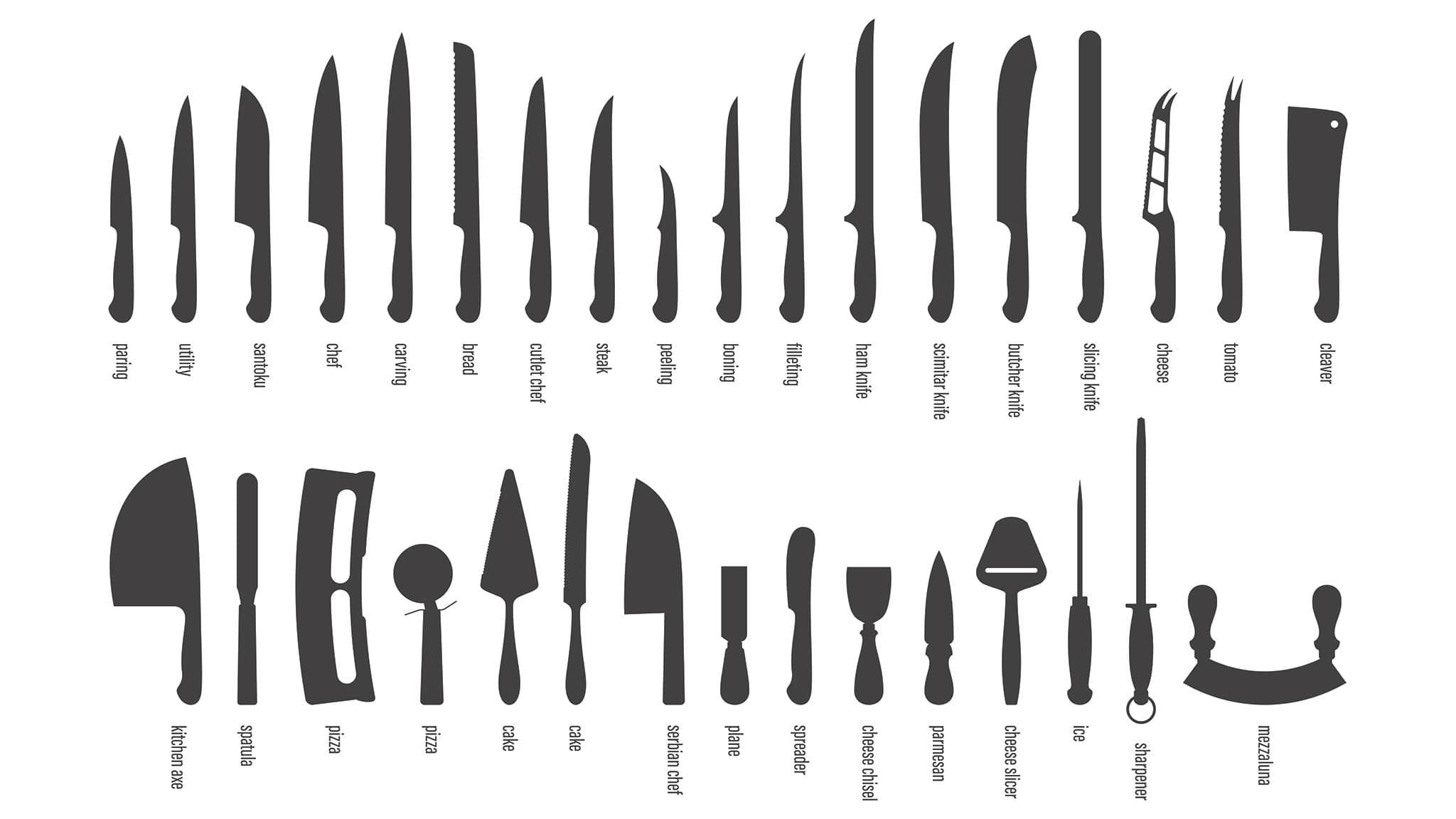
It is a household tool for cooking. With a universal or special purpose. The former includes: slicing, chopping, dividing, dicing, peeling, etc. To the latter: opening oysters, cutting fish, chopping garlic, slicing cheese/tomatoes, slicing frozen food, etc. As an independent subject appeared in the 10th-11th centuries. Before that there were only combat and household knives. The former were used for hunting, the latter in all other cases. From cutting carcasses to cutting cloth. Gradually people realised that a separate cutter was needed for kitchen operations. It’s more hygienic, the blade doesn’t dull as quickly. Ancient chef’s knives were characterised by a thin edge and a sharp angle of sharpening. Their main task was to cut food. Today there are more than 20 types of kitchen knives on sale .
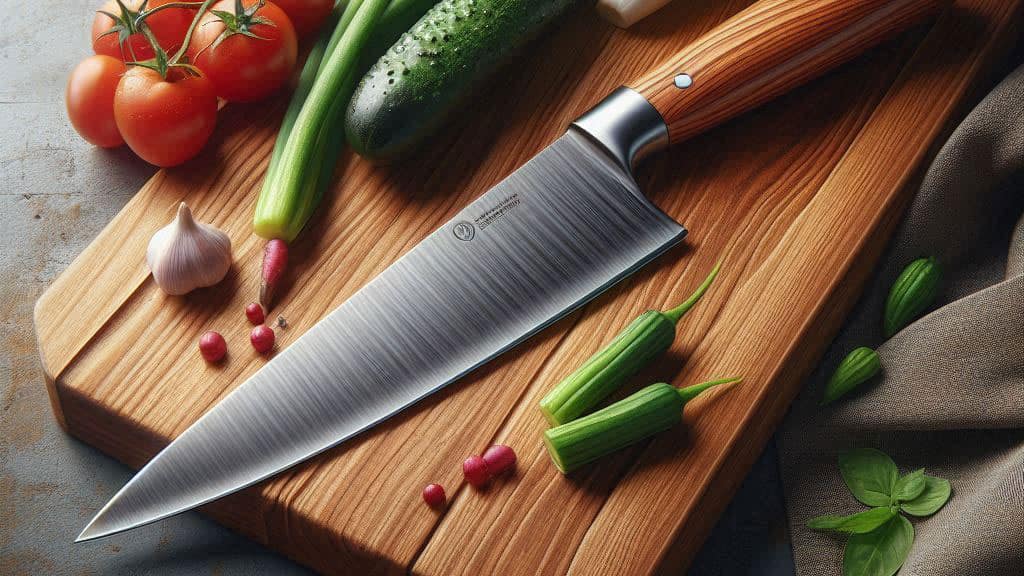
Kitchen knives are arranged in the same way. They have a blade – a visible part with a sharp cutting edge. And also the handle – a holder made of non-slip material, which lies precisely in the palm of the hand. Depending on the type, they are equipped with a full or shortened list of parts listed below.
The blade:
On the hilt:
Any cookware and accessories shop has a plethora of home cutters. However, the variety is rather confusing than inspiring. Models are different in shape, width, length and other parameters. But look closely, you’ll see commonalities. This is what kitchen knives can be.
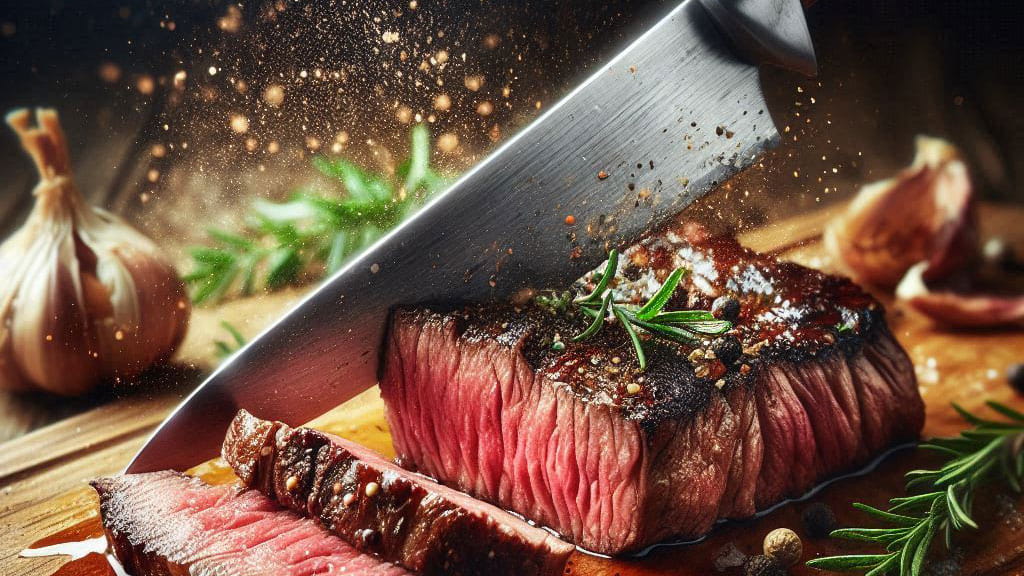
The material from which the handle of the knife is made does not matter much. The main thing is that it should be comfortable and not slip in the hand, so it is better to avoid cheap plastic models. More detailed consideration requires the question of the material of the blade.
What is better than a ceramic knife or a steel knife? Both are respected among buyers. Have a number of common and exclusive pluses. For clarity, we collected the characteristics in the table.
| Parameter | Steel | Ceramic |
| Composition | Stainless steel of food-safe grades. | Zirconium dioxide, a compound of the natural mineral zircon. |
| Purpose | Handles texture-dense ingredients including meat/tendon/skin. Depending on the thickness and shape of the blade, suitable for chopping bones. | For thin slices and slices. For foods with a fragile/tender texture. For festive serving. |
| General advantages | Does not rust. Does not react with the contents. Does not stain. Does not absorb odours. Easy to clean. Modern design and aesthetics. | Hypoallergenic. Solid. Does not strip excess layers from the product, does not deform ingredients. Long retains the factory sharpening. Does not trap bacteria, hygienic. |
| Features | Hard, not brittle. Will not deform/break from drops. Heat resistant. Easy and quick to sharpen at home. Automatic washing is allowed. | Hypoallergenic. Solid. Does not strip excess layers from the product, does not deform ingredients. Long retains the factory sharpening. Does not trap bacteria, hygienic. |
| Nuances | Rough mechanical operations dull the blade faster. Keep dry. | Requires careful handling. From a fall, it can crack. |
Professional chefs recommend assembling a set of kitchen knives, in which there will be steel and ceramic. Materials do not exclude, but complement each other.
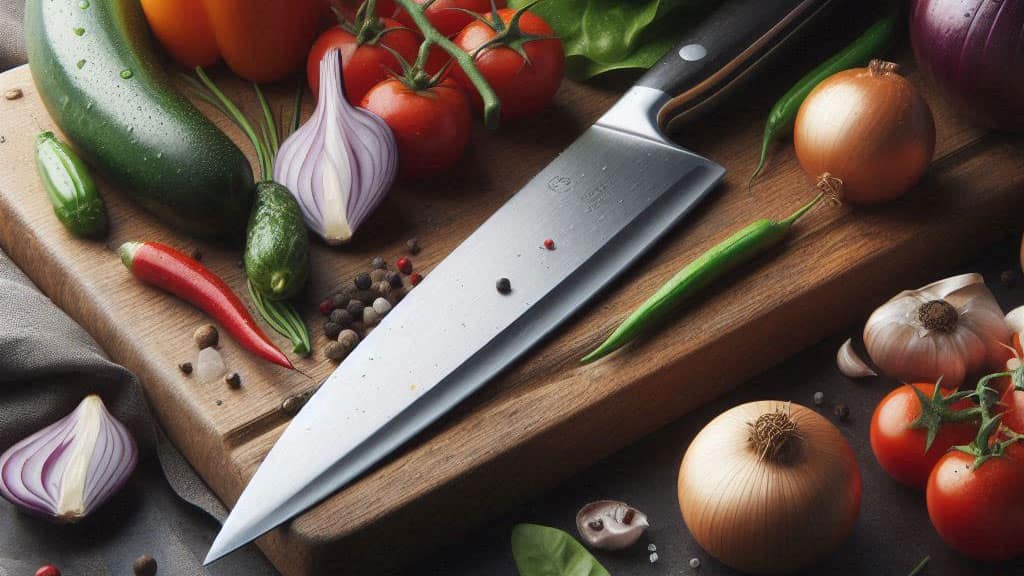
Buying a set of kitchen knives can be difficult. Without the help of a specialist, it is difficult to understand which tool to take. After all, they come in not just different lengths, but also shapes! Do not panic. In everyday life, only four varieties are needed.
Straight knives are a classic. They have a smooth blade with a two-sided symmetrical sharpening. The blade is smooth, with a point suitable for neat cuts and punctures. For example, in the case of peels. Suitable for foods with a dense structure (meat, poultry, sausages, cheeses, some types of fruit and vegetables).
Serratedknives are otherwise known as serratedknives. Their blade is similar to a saw. The cutting edge consists of small zigzags. The blade is long, moderately wide. Smoothly glides, does not crumble, does not tear the edges of ingredients. For slicing fresh bread, baked goods or frozen food.
Wavy knives, like the previous type, do not have the usual sharpness. The tip of the product is rounded, and the blade resembles sea waves. It is designed for the most delicate operations. For example, cutting tender meat into thin slices. And it is also used to cut cakes, rolls and other sweets.
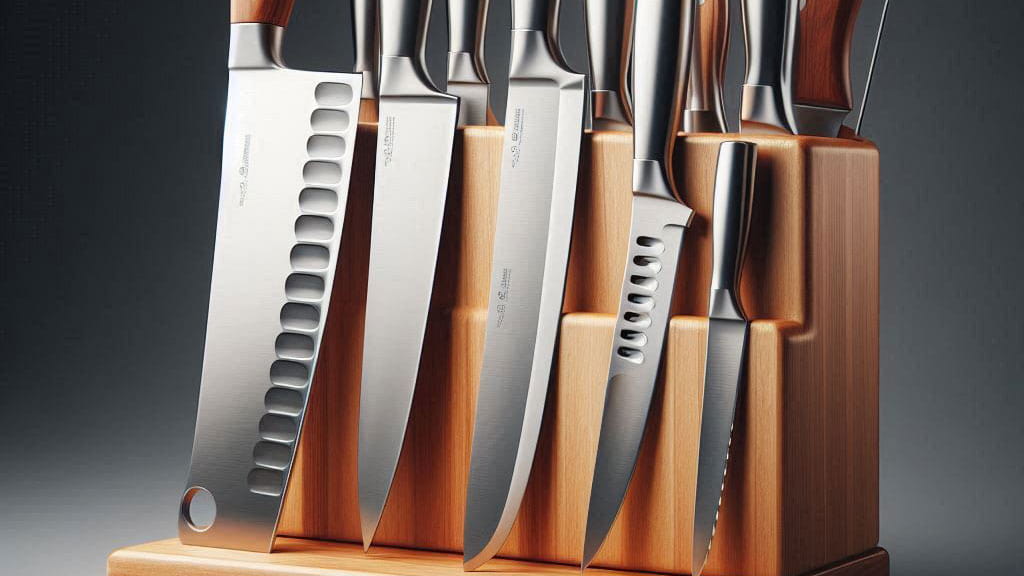
Knives with notches. The second name – with pockets. They look like straight knives, but the blade is wider. Along the blade, rounded hollows are pressed out. They prevent food from sticking. Good for festive slicing.
A meat knife is otherwise known as a butcher’s knife. Already by the name it is clear that it can not be fragile. It is an impressive cutter with a massive handle and a large blade. Withstands prolonged loads without losing efficiency. Used to remove skin, cartilage and tendons.
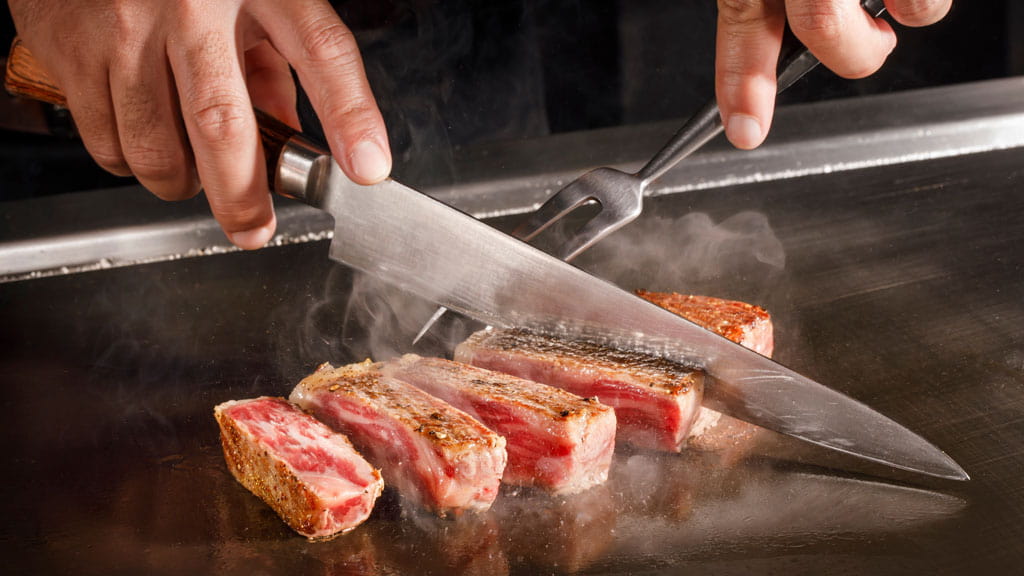
Fish knife or fish knife is a Japanese invention. It is used to cut boneless fillets for sashimi and sushi. It is used for removing skin from carcasses, as well as for slicing small and medium-sized fish. The blade is narrow, the point is thin and the sharpening is often single-sided. This gives a cutting angle of 15-17 degrees.
A bread knife is a tool for soft and slightly stale bakery products. Batons, loaves, baguettes, pretzels. Its highlight is the serrated blade in the form of a “saw”. It does not damage the fragile edges of baked goods, does not crumble or crumple the slices. The total length of the kitchen knife is from 25 cm. The blade is long, from 13 cm. Flat, the point is not sharpened. A solid knife with a special blade is also suitable for cutting products with a hard shell, such as watermelons, pineapples and melons. Models with a serrated blade almost do not need sharpening, but if the knife does become dull, it is better to contact a workshop.
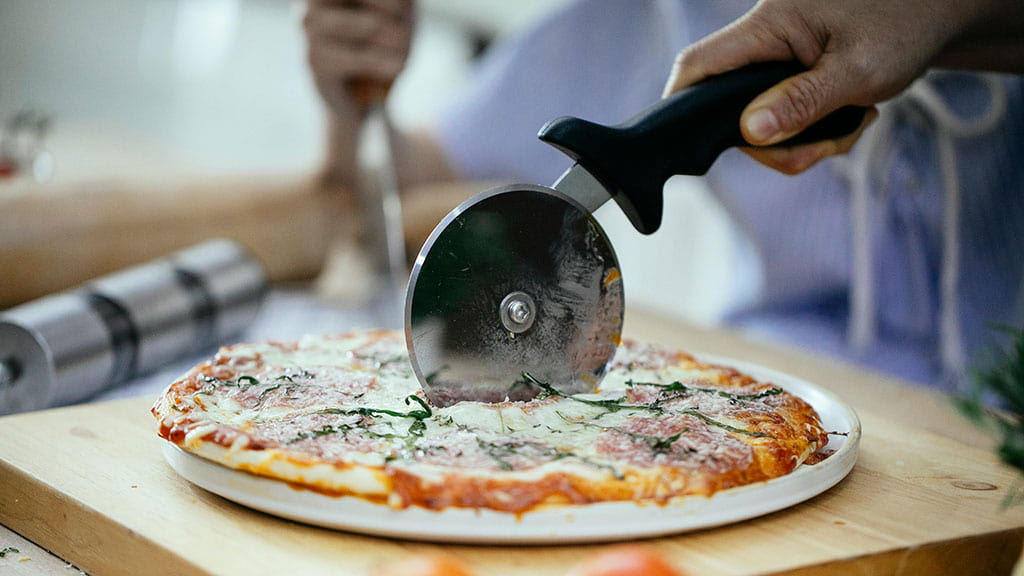
Pizza knife – a cutter with a round blade with a diameter of 8 cm. It is made of stainless steel. Flat, has a double-sided symmetrical sharpening along the entire cutting edge. The handle is attached from above and does not interfere with the free movement of the blade. Even with light pressure, it can handle the structure of crispy dough and generous filling.
The pastry cutter is a similar design. It too has a roller principle of operation. The blade is smaller in diameter, but the number of cutting parts in the nozzle from 3 pieces. With their help, the dough rolled into a pancake is cut into noodles. For example, for homemade pasta. Depending on the model, the nozzles can be interchangeable, including shaped.
Kitchen knives for vegetables are characterised by a short, thin blade of up to 10 cm and a robust handle of 11 cm or more. The angle of their tip is sharper to easily peel tomatoes, peel aubergines, courgettes, make holes in pumpkins, remove potato “eyes”. There are also models with a hook-shaped blade in the form of a claw and those that resemble a santoku. Knives with a serrated blade can easily cut through the hard skins of foods.
A fruit knife is similar in appearance to a vegetable knife. It too has a short, flat, double-edged blade. In addition to cleaning, it is designed for delicate slicing of oranges, bananas, mangoes. The product is indispensable in families that follow a healthy diet and love fruit juices and smoothies.
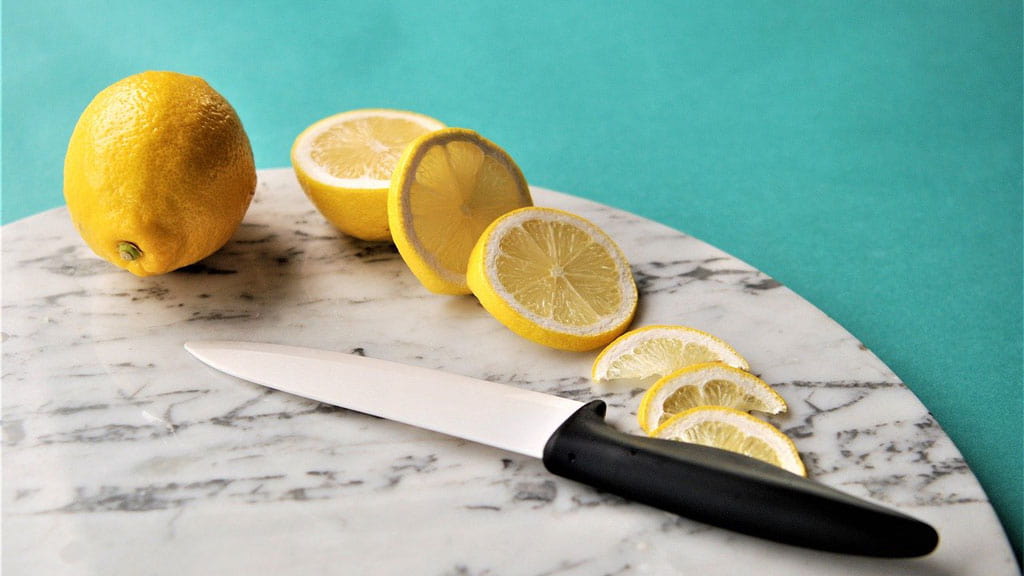
Decorating knives are a whole section of shape cutters. A variety of wavy shaped blades form the basis. They include vegetable graters, fruit slicers, corners, sharpeners, pulp peelers, spoons and more. With the help of such knives create shaped compositions of watermelons, melons, apples.
A paring knife is a gastronomic knife. It is a long product up to 40 cm. It is used for slicing smoked or cooked meat, fish, sausages, ham, carpaccio, filled rolls. The design allows you to slice different textures of ingredients, including soft, hard, mixed ingredients.
Cheese knife – a tool for soft and hard cheeses. Depending on the consistency of the product, it has the shape of a metal spatula or a thin string. With its help, create appetising cheese assortment, canapés and cheese plates. There is also a knife with a flat blade, in which holes are provided. They prevent the cheese from sticking.
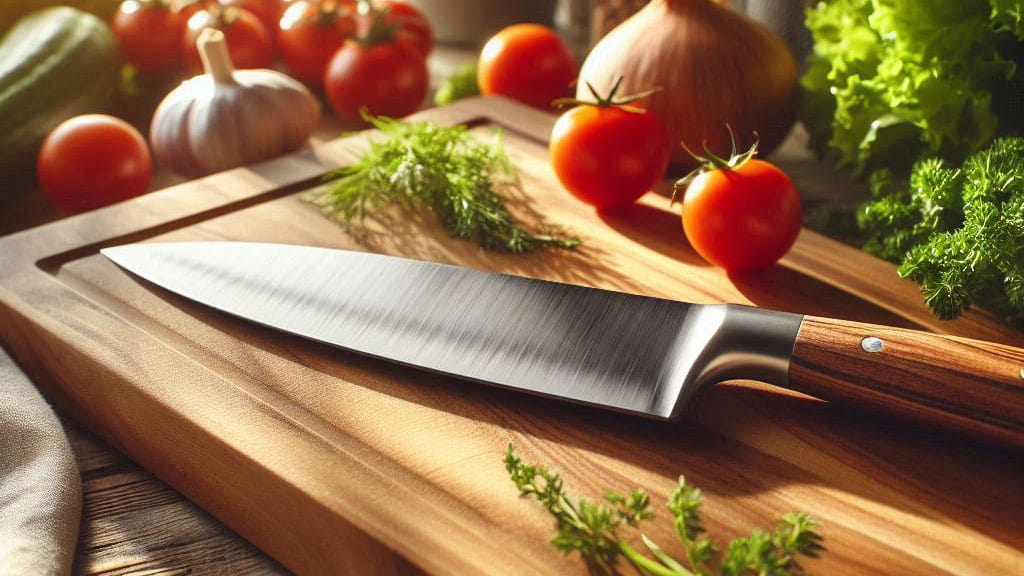
The chef’s knife or chef’s knife kitchen knife is the main one. The length of the blade from 15 cm, the thickness of 2-4 mm. The handle is long, reliable finger rest, the blade is wide. You can cut, press (flat), use when turning. The peculiarity of the product is in the shape. The blade is curved. It is rocked back and forth, cutting onions, cucumbers, herbs.
Chef knives are appreciated for their versatility. A long knife with a massive handle and a wide blade gives the chef a lot of possibilities:
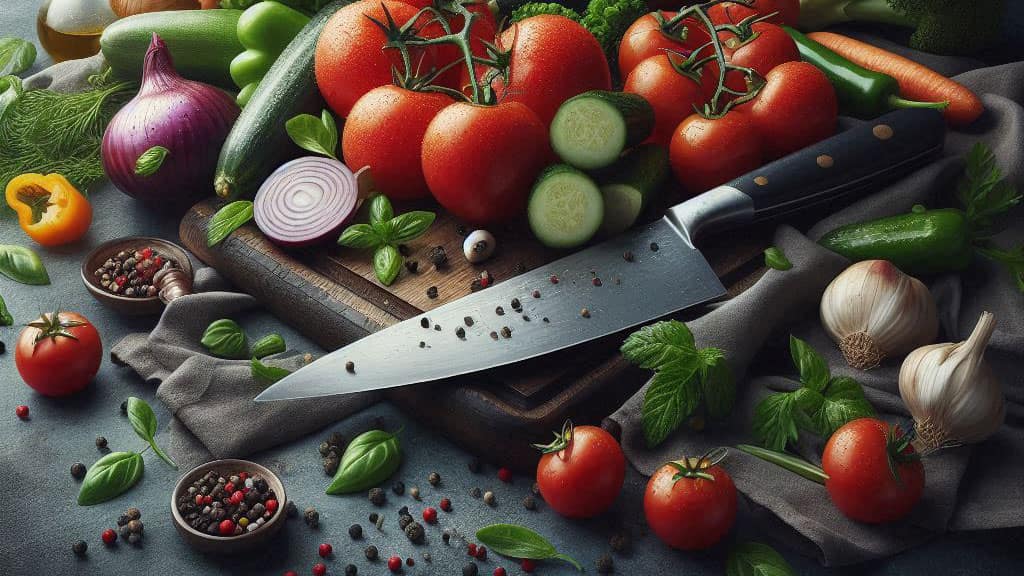
The blade length of chef knives varies from 15 to 30 cm. However, blades shorter than 20cm are awkward to use and blades over 30cm long require a lot of workspace. The optimum length of a chef’s knife blade for home kitchens is 20-25 cm.
Universal knife – an analogue of the chef’s knife, but with a narrower blade. As a rule, this is an additional cutter, which is put in sets “for all occasions of cooking”. You can do everything or almost everything with it. Slicing bread, vegetables, dicing meat, salad. For operations like peeling carrots, it is better to have a special tool.
Deboning knife – a cutter for separating meat fillets from bones. Indispensable when cutting animal carcasses. Its geometry is adapted for high mechanical loads, as well as for delicate operations such as incisions or punctures. The blade is flat, not long. The handle is the same size or slightly larger.
The hatchet knife is massive, heavy, designed for the appropriate tasks. It is the tool of the cliched butcher from Western films. It can chop bones and frozen meat. The wide, thick, rectangular blade is 15 to 18 cm long and has a strong edge and a decent angle of descent. The handle is non-slip and holds the metal blade firmly in place. This gives a secure grip in the hand. Ingredients with its help are cut with sharp chopping movements. A heavy accessory is used for cutting carcasses, chopping bones or frozen meat. The presence of such a knife in the home kitchen is not necessary at all.
The santoku knife is a representative of the category of “Japanese kitchen knives”. The name translates into Russian as “three advantages”. The first is lightness. It is almost weightless, because it does not have a weighting device in the form of a massive bolster. The second advantage is the thin blade. It is suitable for slicing, chopping, chopping, chopping. The third advantage – high versatility. With the help of santoku you can do 90% of culinary operations, except chopping. The cutting edge is straight, without a bend.Santoku is shorter than a chef’s knife: the length of the blade varies from 12 to 20 cm. The santoku is not really suitable for cutting greens. However, the santoku makes it easy to slice vegetables, fruit, meat, fish and poultry. Its blade is thinner than that of a chef’s knife, so it allows for finer slicing. Special notches on the blade prevent food from sticking during cooking.
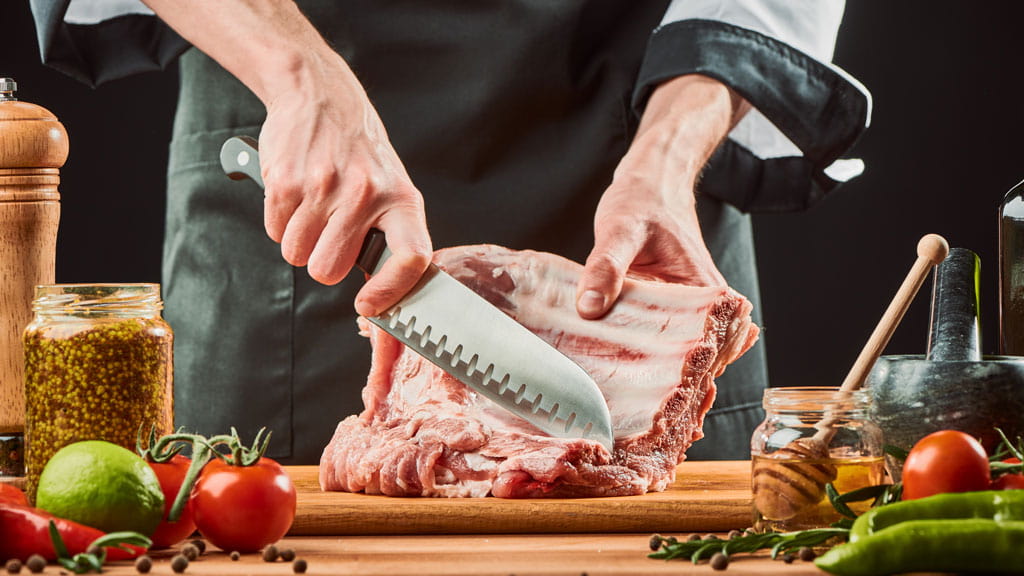
A filleting knife is an accessory for cutting large fish into slices, as well as for separating delicate fish fillets from bones. For this purpose, it has a thin, flexible but very strong blade of up to 30cm. The product requires skill. It is essential for those who regularly include fish dishes in their diet and regularly cut up fish. A relative of the sirloin knife is a deboning knife with a short, wide blade, designed to remove meat from the bone.
The can opener is a familiar can opener. Design and technology have ennobled its appearance, but the main thing remains the same. It’s for tin cans. The safe design is attached to the edge of the metal container. Opens it under the influence of mechanical torsion. Some are supplemented with a function for bottles.
Knife for oysters is a small accessory with a short blade, which allows you to easily and quickly open the flaps of the shell of the mollusk. To find an analogue for a strange tool is quite difficult: even a universal chef’s knife can not cope with small, tough oyster shells.
In addition to the above, there are several other types of specialised knives. For example, a knife for steak, for cheese and even for tomatoes. However, they are rarely used even by professionals: a universal chef’s knife is a serious competitor to narrow-profile models.
You want to enjoy appetising treats every day. And on holidays even more so. Buy a good kitchen knife to turn cooking into a pleasure. It will help not just to cut. The aesthetics of dishes depends on its quality. What to look out for?
1. Purpose. An accessory with a wide application is good for operations without which no cooking can do without. Such an accessory is purchased in addition to the existing set. With specific functions it will cope worse. Planning a special dish? Buy the appropriate tool.
2. Blade. Steel for kitchen knives should be included in the list of safe components. The right ceramic kitchen knife has no external defects. Scratches, chips, other damages are inadmissible. Carefully inspect the surface. Remember that the steel cutter is stronger. It can withstand sharp movements (chopping, cutting, cutting hard/frozen foods). The ceramic analogue is good for delicate processing such as slicing.
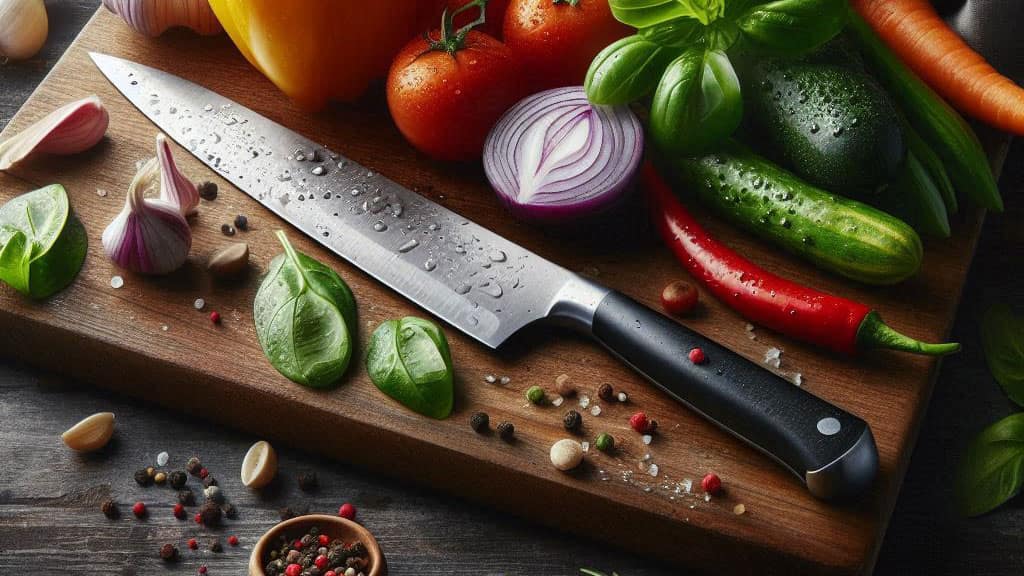
3. Thehandle of a kitchen knife is the most important element. Check in the shop to make sure it fits in the palm of your hand. It doesn’t protrude, it doesn’t slip. The surface should not be coloured. Preferably textured relief or a holder made of polypropylene. The material is wear-resistant, does not absorb grease, easy to clean, not afraid of automatic dishwashers.
4. Balance. The best sets of kitchen knives are well balanced. The handle and blade balance each other. This is often achieved with the help of the bolster and the tip. If you place such a knife on the pad of your finger, like a scale, it will come into balance.
5. Rivets. The most reliable fastening is considered to be metal rivets, which hold the handle on the metal blade. Two or three are the optimum number to keep the handle from coming off.
6. Sharpening. The best kitchen knives have a two-sided symmetrical sharpening. That is, the blade is sharpened at the same angle on both sides. The cut is thin, clear, without jagged edges and crumbs. When buying, ask how often and with what you will be able to sharpen the knife.
There should be at least 3 knives in your home kitchen: a vegetable knife, a bread knife and a chef’s knife.
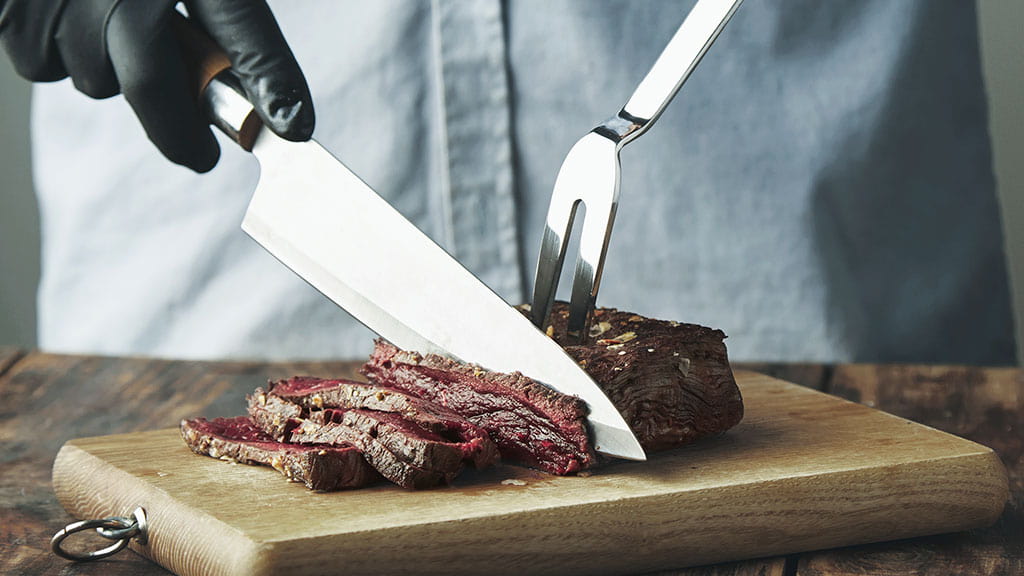
Even the best kitchen knives require care. It prolongs the life cycle, does not let the accessory “age”. Manufacturers of kitchen knives recommend storing them separately from other cutlery. Contact is undesirable, because it dulls the blade. It’s also unsafe. You can hurt yourself when you reach for a fork or spoon. Keep knives in a plastic-filled table stand or on a magnetic bar. Take care to keep them dry at all times. Steel and ceramic blades are safe from water. But they can leave an unsightly white deposit on the surface. During use, keep an eye on the handles. Do not use knives with broken holders. The structure loses its strength. Check the sharpness of the blades regularly. Use a sharpener approved by the manufacturer for dressing. To maintain sharpness, avoid metal and stone boards in favour of plastic and wooden ones. Wash products immediately after use. Give preference to manual cleaning. Only knives that are authorised for automatic washing can be put in the dishwasher. Do not leave knives in a visible place, especially if there are children in the house.