
Newsletter Subscribe
Enter your email address below and subscribe to our newsletter
Enter your email address below and subscribe to our newsletter

The trend of giving potted orchids instead of a traditional bouquet is gradually waning. But even without this, almost every home has at least one tropical plant (e.g. phalaenopsis, vanda, dendrobium, cymbidium, etc.). Someone managed to make friends with capricious epiphytes and achieve almost uninterrupted flowering. Someone is happy and 3-4 flowers on a single arrow. And some are happy to see only wiry leaves and aerial roots year after year.
There are quite a few potential reasons why an orchid does not bloom. By detecting and eliminating the problem in good time, you can help your favourite orchid to shoot again and form buds.
Orchids have their first flowering between 1.5 and 3 years of age. So if you are growing a tropical beauty from a baby orchid, be patient. Although it happens that the epiphyte is still too young, but has already released an arrow. Sometimes a flower stalk can grow even from an undivided baby. In this case, be sure to break off the shoot, as premature flowering will exhaust or even kill the plant.

Orchids are affected by mealybugs, which suck the juices out of young buds, causing them to wilt. Other pests can also hinder the normal development of the plant: pinworms, whitefly, mites, thrips, nematodes and other pests.
Feed epiphytes should be fed during the period of active vegetative growth with compositions specially designed for them. Universal fertilisers for ornamental flowering orchids are not suitable.
The reason why the orchid does not flower, but the leaves grow and new aerial roots appear, may be due to an excess of fertilisers with a high nitrogen content. Phosphorus additives can help to stimulate bud formation in epiphytes.
Orchids need warm and humid air (ideally around 25°C with 60-80% humidity). It is strictly forbidden to put the pot in draughts. Regular spraying or using a humidifier will help to solve the problem of dry air during the heating season.
Relative coolness (17-22°C) epiphytes tolerate more easily than drought and heat. Phalaenopsis, for example, can hold its flowers well at low temperatures, while in dry and hot rooms it often drops its buds and blooms.
Water epiphytes infrequently but abundantly. The substrate and roots should dry out between waterings. Use soft, slightly warm water. Once a week you can lower the pot into a basin of water for 20-30 minutes, so that the substrate is well saturated with moisture. In this case, the roots should not be in contact with water for a long time, so as not to rot, so do not forget to drain excess moisture from the tray.
Orchids do not need much light to grow and develop. But it is difficult to awaken a dormant bud without good lighting. It is important to avoid direct sunlight in summer. The light day for epiphytes should last at least 10 hours. Therefore, if the arrow appeared in winter, use a powerful phytolamp. Position the light source directly above the plant. At the same time, make sure that the leaves do not get hot.
A flowering orchid, particularly Phalaenopsis, sharply reduces the need for additional light. A plant that has opened all the buds, you can safely decorate the darkest corners of the flat.
If you have practically turned the flat into a tropical paradise, and epiphytes still grow, give new leaves and roots, but no arrows, it’s time to think about more radical ways to make the orchid bloom at home. You can often hear that it is not necessary to blow dust from a capricious plant. It is much more effective to create a real stress for him. And here’s how you can do it.
This method will work for Phalaenopsis, Wanda and other monopodial (single top growing point) orchids that don’t have a dormant period. A temporary drought will help awaken dormant buds even if there is insufficient light. To do this, increase the watering intervals by at least 2 times so that the substrate and roots dry out completely. Refuse spraying, fertilisers and biostimulants for a while. Such a regime withstand 1-2 months, and then return to the previous watering scheme.
Orchids can be left in a cool place for a couple of weeks, or during the same period take them out to the balcony at night every day. The difference between day and night temperatures should be about 6°C. At the same time, the thermometer should not drop below 16°C.
If you don’t want to mess around with a capricious orchid, calculating the days between waterings and regularly checking the thermometer, just put the pot in a cool, dark place, for example in a cellar or pantry. But don’t forget to return the flower from its exile after a couple of weeks.
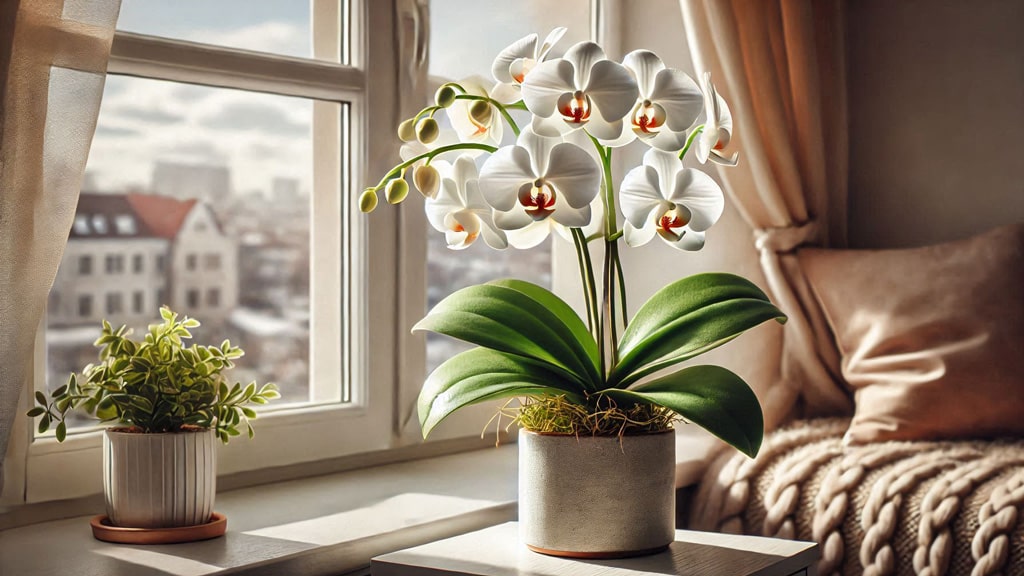
Potassium and phosphorus supplements are a stimulant for bud ejection. To accelerate flowering in the presence of a new or old peduncle, you can use cytokinin paste. To do this, find a bud and denude it by making a neat cut and removing the top scale. On the exposed area, apply an even layer of paste.
On forums you can meet and another advice on the subject of what to do to bloom orchids, – “hot shower”. First, it is recommended to water the plant in the usual way, and after 30 minutes – move the pot under the jets of hot water and pour the entire epiphyte. Take a shower orchid should not take longer than 1 minute, so as not to burn the roots and leaves. After the procedure, stop watering and spraying for 2 weeks. Sometimes all this gives results. However, the risk of ruining the plant is also high.
If you still decide to take a risk and pour boiling water on orchids, keep in mind that the “boiling water” should not be hotter than 35-37°C. In addition, there are types of orchids to which such a procedure is strictly contraindicated, such as cambria, slipper orchids, Miltonia, etc.
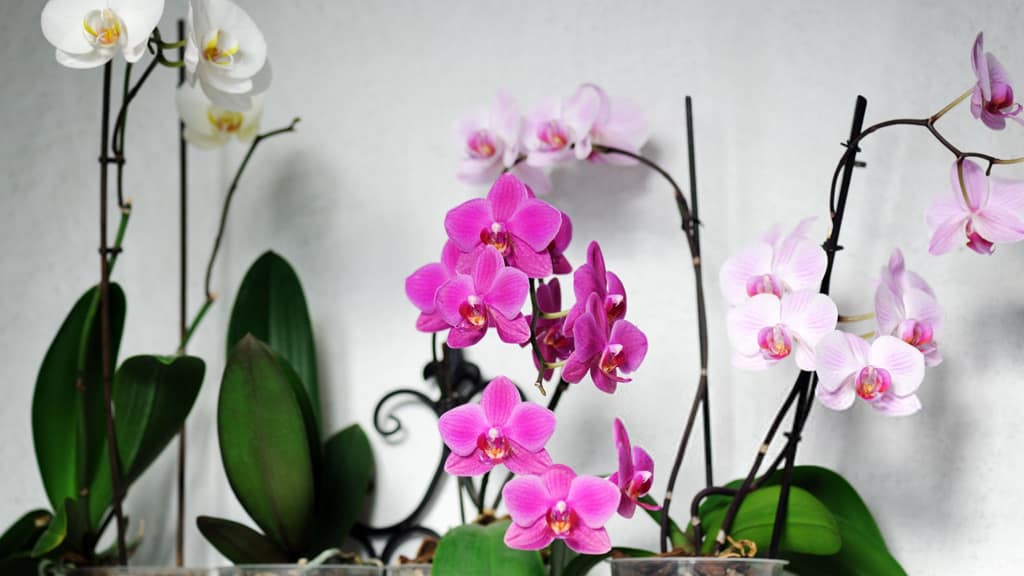
If you managed to make orchids bloom or at least release arrows, do not think that now you can just admire the tropical flower and do nothing. Be sure to follow our tips to make the blooms last as long as possible:
It is also worth knowing what you can not do with an orchid during budding and flowering.
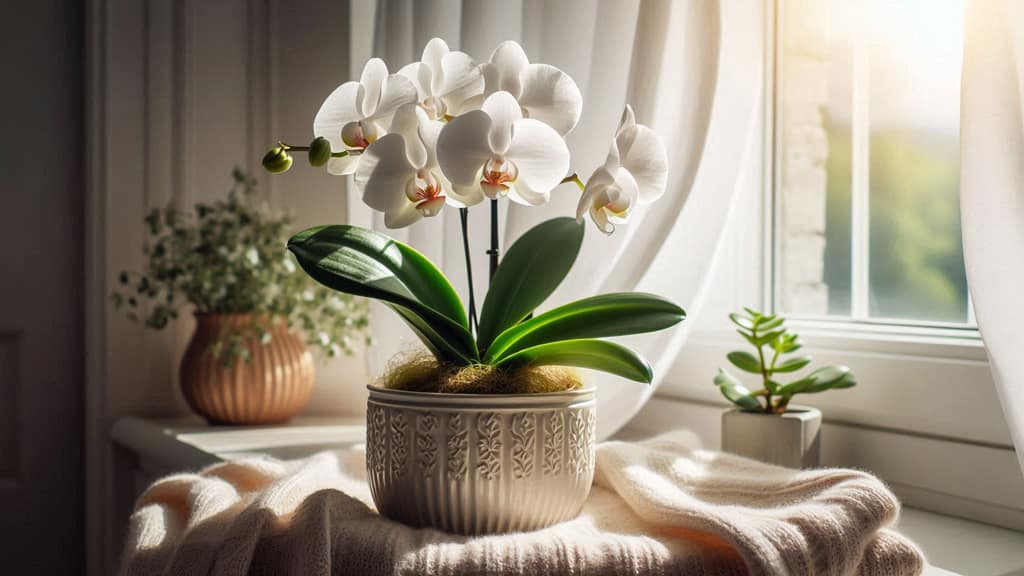
When the orchid has stopped flowering, do not rush to cut off the peduncle. Firstly, dormant buds may awaken after a while. Secondly, flower stalks have a growing tip. If it remains green, there is every chance that it will continue to grow and new buds will appear on it. This can happen during flowering or 1-3 months after the flowers have fallen. There is also a chance that the tip of the peduncle will not continue to grow.
If the tip is blackened, yellowed or shrunken, the peduncle can be removed – either completely or only the part where the flowers were (just above the last dormant bud). Many breeders leave all the peduncles, because it is easier to achieve repeated flowering, because each bud can form a lateral peduncle or a baby. But keep in mind that by leaving an old peduncle, you inhibit the development of new ones. And after all, the decorative value of a blossoming orchid on a new shoot is much higher than if buds appear on a side shoot.
If the peduncle with the cut tip has started to dry out or turn yellow, it must be removed. Only a small “stump” with at least one bud should be left.
A common question is whether it is possible to transplant a flowering orchid. It is better not to do this, because at this time the orchid will again experience stress. Repotting should be postponed until the plant has fully flowered. After placing the epiphyte in a new pot, leave it without watering for a while. This will allow the plant to acclimatise more quickly and prevent the roots damaged during transplanting from rotting.
It may seem that often blooming orchids – this is an unattainable goal. But it isn’t. When you understand what epiphytes like, when you learn to recognise their desires and respond to their needs, they are sure to reward you with numerous buds.

Enter your email address below and subscribe to our newsletter