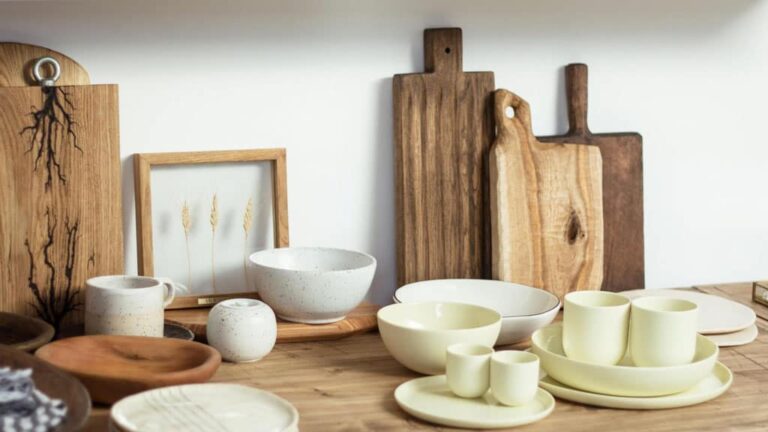

Wood is considered the best material for chopping boards. Wood is durable, it doesn’t dull knives and has natural antibacterial properties. But shops offer so many different models that it’s easy to get confused. Let’s find out how to choose a durable and comfortable utensil for the kitchen!
If you often cut meat and fish using professional knives, your cutting equipment should be durable. Choose products made of hard wood – oak, maple, cherry, beech. Avoid softwoods, as they have a loose texture and strongly absorb moisture.
The surface should be even and free of knots.

Here are five more factors that determine the quality of a kitchen accessory:
When choosing, it is also important to consider the cost of the product.
Themain advantage of cutting utensils made of wood is a dense but elastic texture. Thanks to this, the surface remains undamaged for a long time and does not dull knife blades. Wooden products are resistant to shocks and temperature fluctuations. With good care, they last for decades.
Another important advantage is wood’s natural ability to kill bacteria. Studies show that germs remaining in cuts on the surface disappear in 3-10 seconds.
Wooden utensils do not slip during use, which is important for safety. They are easy to care for – just wash them after use and occasionally oil them with mineral oil.

An important reason why home cooks prefer wood chopping boards is the aesthetics. The beautiful utensils fit into the kitchen design, creating touches of trendy eco-style.
Among the disadvantages of wooden products note the incompatibility with the dishwasher. Another disadvantage is the considerable weight, especially for large-sized utensils.
When buying equipment for the home kitchen, it is important to consider the type, hardness and porosity of wood. Hard hardwoods are the best for culinary use, but products made of them are not cheap. Let’s consider the most popular materials for making kitchen utensils.
Experts call the wood of black and walnut the best option for cutting boards. The first reason for this is its optimal hardness. A walnut panel is not so easy to damage with a knife, while the blades remain sharp for a long time.
The material is characterised by low porosity. It is enough to lubricate the product with mineral oil once a month, and it becomes impervious to moisture. The beautiful appearance of the wood with alternating dark and light fibres is also attractive.
This wood species is valued for its hardness. The strong and resilient texture remains smooth for a long time, without cuts or dents. For caring owners, beech utensils last for 5-6 years.

The material has strong antibacterial properties, which is important for maintaining hygiene in the kitchen. It does not contain any substances that can cause allergies. Thanks to its light colour and straight, even fibres, beech utensils look spectacular in the kitchen and give it a classic look.
This material is a hard wood, so it can withstand everyday physical stresses well. Oak is less susceptible to cracking and warping than other types of wood. The fibres of the wood are characterised by a low content of natural resins. This means that no wood sap will protrude on the surface. The resilient grain protects knife blades from premature wear. Another reason for oak’s popularity is the beautiful fibre pattern, which gives the kitchen a touch of sophistication.
The main disadvantage of the material is its high porosity. Oak products strongly absorb moisture, so they need careful maintenance.
The wood of this tree has a circular-porous texture and high hardness. Thanks to these qualities, ash planks are characterised by a strong and resilient surface. The pleasant light colour makes ash wood utensils an excellent decoration for the kitchen.
Aserious disadvantage of ash wood is its high porosity. Moisture and food residues accumulate in the pores, causing germs to multiply. Although ash wood naturally destroys bacteria, if poorly maintained, the hardware can become odourless, cracked and even rot. Thorough washing, drying and oiling with mineral oil can help reduce porosity.
Softwood is not a good material for chopping boards. Pine wood is friable, so it is unstable to moisture and quickly develops cuts and stains. But the cost of the material is low, and it is often used as an alternative to expensive hardwood products.

Kitchen utensils made of pine have a pleasant odour. But if the wood is not properly harvested, resin can remain in the fibres, spoiling the taste of anything that is cut on the surface. Therefore, pine plates are not suitable for cutting meat, fish, vegetables. They are usually used for cutting bread and products that contain little moisture – hard cheese, dried meat, dried fruit. Due to the beautiful pattern, pine wood products are often used to decorate the kitchen or serve snacks.
The first condition for the longevity of the equipment is timely washing. If you cut a small amount of food, for example, an apple or a slice of bread, it is enough just to shake off the crumbs. But after working with wet food, the board should be washed immediately.
Wooden objects are not compatible with the dishwasher, as hot water and aggressive detergents destroy the texture of the wood. Only hand washing with warm water and soap is allowed. After cleaning, wipe the product with a towel and leave it in an upright position to dry.
Here are four more useful tips:
Even with good care, wood can warp and crack. If this happens, the utensils will have to be replaced.

Wooden utensils should be kept away from moisture, preferably in an upright position. The easiest option is to lean the product against the wall in the evening, after washing and wiping. In this state, both sides will be able to dry completely overnight.
There are special stands for cutting boards. They consist of holders 2-3 cm wide, of different heights. But such a device is not suitable for massive professional utensils.
If there is a free drawer in the kitchen cupboard, boards can be stowed there, separating them with microfibre cloths. The risk of damage is reduced if you stack items alternating the direction of the fibres.
Beautiful wood utensils can be hung on hooks or placed in a kitchen basket. This method of storage provides protection from moisture and improves the design of the room. If only one board is used in the household, it can be placed overnight in a dish drainer or pot lid holder.
In a small kitchen, where you have to save space, it is recommended to buy a hanging drying rack for boards. It can be attached to the bottom or inside of a wall cupboard door.